
When the power goes out in town, it usually comes back in a few hours. When it goes out on a rural road in the Coast Range foothills, trees are often involved, and the wait can be longer. Utilities themselves say the last pockets of customers to get power back tend to be the rural ones, because crews reach them last. If you also depend on a well pump, a woodstove blower, a chest freezer, or medical equipment, an outage is more than an inconvenience.
A standby generator service in Blodgett, OR solves that, and natural gas is the fuel most people ask about first. But there’s a question that comes before cost and size: do you actually have natural gas at your property? This guide answers that, then walks through how these systems work, what they power, how to size one, what they cost, how they compare with propane, and how to keep one reliable.
Quick Takeaways
- A natural gas standby generator is usually worth it when outages are frequent or long, you have critical loads (well pump, heat, medical, food storage), and a gas line already reaches your property.
- If you don’t have natural gas service, propane is the realistic alternative. Don’t assume a pipeline can be extended cheaply.
- Typical installed cost is roughly $8,000 to $16,000 for a whole-house unit, depending on size, gas line, and site.
- In Oregon, a transfer switch is required, and the work needs a permit and a licensed electrician.
- Size the generator to your real loads (especially well pumps and heating), and remember natural gas lowers a unit’s output by roughly 8 to 12 percent.
- Plan for annual maintenance. Most failures come from skipped service, dead batteries, or fuel problems.
What Is a Natural Gas Standby Generator?
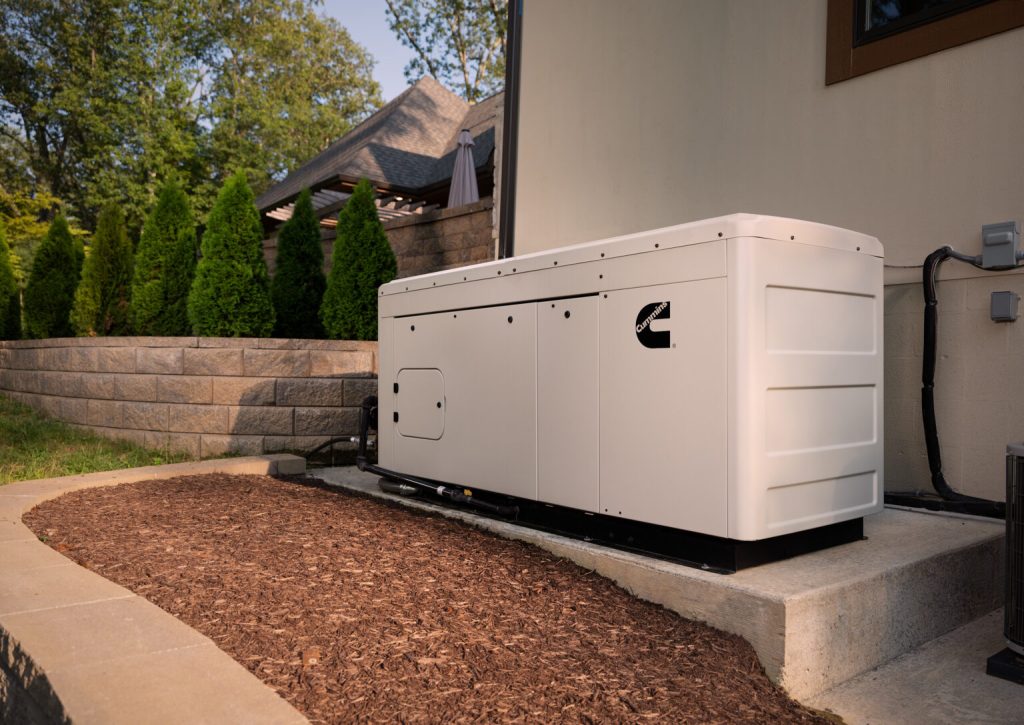
A standby generator is a permanent unit that sits outside your home, usually on a pad, much like a central air conditioner. It connects to your electrical panel through an automatic transfer switch and to a fuel supply. When utility power fails, it starts on its own and powers your home.
A natural gas unit runs on gas from a utility pipeline, so there’s no fuel to store, refill, or haul. That’s its main advantage. As long as gas keeps flowing, it can keep running.
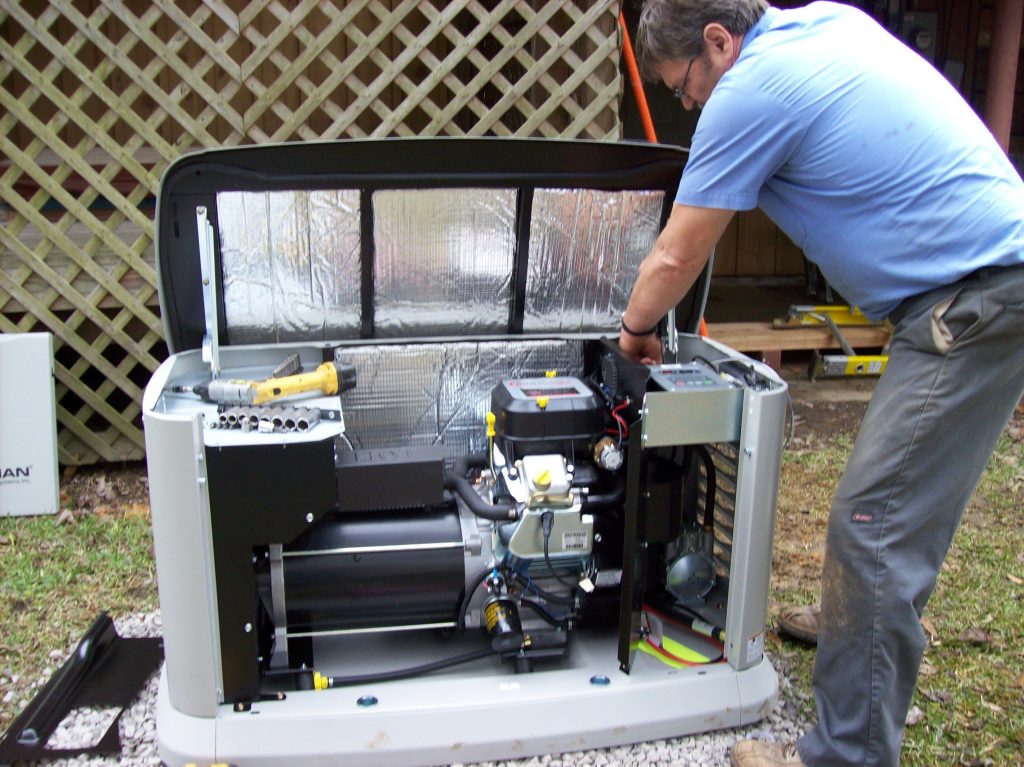
The system has four main parts:
- The engine-generator in a weatherproof enclosure
- The automatic transfer switch (ATS), which senses outages and moves your home between utility and generator power
- The fuel connection, which is a gas line and regulator in this case
- The controller, which handles starting, testing, and shutdown
A standby unit is different from a portable generator. A portable unit needs you to wheel it out, fuel it, start it, and run cords or a connection. A standby unit handles all of that without you.
Why Consider a Standby Generator for Your Home in Blodgett, OR?
Blodgett sits in the timber country west of Corvallis. A few local factors make backup power more than a luxury:
- Trees and rural lines. Winter wind, snow, and ice bring down limbs and lines. Rural areas tend to be restored after denser ones.
- Well water. If you’re on a well, no power usually means no water.
- Heat and comfort. Furnaces, heat pumps, and blowers all need electricity, even when the fuel is wood or gas.
- Food and medical needs. Freezers, refrigerated medications, and powered medical devices can’t wait days.
- Utilities differ. Benton County customers are served by Pacific Power or by Consumers Power Inc., a rural electric cooperative, so which number you call during an outage depends on your provider. TM Electric’s own site says outages in this part of Oregon happen most winters.
Is it worth it? A quick test:
| It’s likely worth it if… | It may not be if… |
| Outages last many hours or days | Outages are rare and short |
| You have a well pump, medical needs, or work from home | You can comfortably leave for a few days |
| Natural gas already runs to your property | You’d need a long, costly gas line extension |
| You can budget for maintenance | You’d rarely notice the outage |
If you’re not sure, a smaller “essential circuits” system or a portable generator with a proper transfer switch can be a lower-cost step. More on that below.
How an Automatic Standby Generator Works During a Power Outage
The process happens in seconds, with no one needing to be home:
- Detect. The transfer switch monitors incoming utility power. When voltage drops or disappears, it signals the generator.
- Start. The engine starts, typically within about 10 to 30 seconds.
- Transfer. Once the generator output is stable, the transfer switch moves your home’s circuits onto generator power. It also disconnects your home from the grid, which protects utility crews and your equipment from backfeed.
- Run. The generator powers your home while the outage lasts.
- Return. When utility power comes back and stays stable, the switch moves your home back to the grid.
- Cool down and reset. The engine runs briefly to cool, shuts off, and returns to standby.
The transfer switch matters for safety. Oregon’s Building Codes Division warns that backfeeding a panel from a portable generator without a proper transfer switch can be very dangerous, and the Oregon Electrical Specialty Code requires a transfer switch or other safety device.
What Can a Natural Gas Backup Generator Power in Your Home?
It depends on the size of the unit and how the system is wired. There are two common approaches:
- Essential circuits. A smaller generator powers a chosen set of circuits.
- The whole house. A larger generator powers nearly everything, often with load management that sheds big loads.
| Typical Essential Load | Why It Matters in Blodgett |
| Furnace, heat pump, or blower | Heat and airflow |
| Refrigerator and freezers | Food storage |
| Well pump | Running water |
| Sump or septic pump | Prevents backups and flooding |
| Lights and outlets | Basic comfort and safety |
| Internet and phones | Communication and remote work |
| Medical equipment | Health |
| Garage door opener | Getting vehicles out |
Large electric loads such as electric water heaters, ranges, dryers, and central air or heat pump backup strips can use a lot of capacity. Decide which of these really need to run. Load management can switch them off automatically when the generator is under strain.
How to Choose the Right Standby Generator Size for Your Home
Sizing is where many buyers go wrong. Too small and it overloads. Too large and you pay more than you need to.
Step by step:
- List what you want to power. Start with the essentials above.
- Find each item’s running and starting watts. Check nameplates. Motors, including well pumps, compressors, and blowers, draw much more when they start than when they run.
- Add the running watts, then account for the largest starting surge.
- Decide on the whole house or essential circuits.
- Size against the natural gas rating, not the propane number. Natural gas has less energy than propane, so air-cooled units are derated about 8 to 12 percent of natural gas. A “22 kW” unit is often rated around 19.5 kW on natural gas.
- Add a margin and have an electrician confirm with a load assessment.
Ballpark guidance
Whole-house standby units are typically in the 20 to 26 kW range. One manufacturer example puts a 2,400-square-foot, all-gas-appliance home with one 3-ton air conditioner at about 12 to 15 kW of demand. Homes with electric heat or heat pump strips can need more, or need load shedding.
| Typical Device | Running Watts (approx.) | Notes |
| Refrigerator | 100–200 | Higher surge at startup |
| Well pump (1/2–1 hp) | 750–1,500 | Starting load can be 2–3x |
| Furnace blower | 400–800 | |
| Sump pump | 400–1,000 | |
| Electric water heater | 4,500 | Often excluded or load-managed |
| Central AC or heat pump | 3,000–5,000 | Strips can add much more |
These are rough figures. Always check actual nameplate data.
Don’t forget the gas meter
A 22 kW unit on natural gas can draw around 300 cubic feet per hour at full load, on top of your furnace and water heater. Some residential meters can’t deliver that, which can mean a meter upsize before installation. Ask NW Natural early.
Natural Gas vs. Propane Standby Generators: Which Is Better?
Neither wins everywhere. The deciding factor is often simple: what fuel can you actually get?
| Factor | Natural Gas | Propane |
| Availability | Only if a pipeline reaches you | Delivered to a tank on your property |
| Runtime | Continues while gas flows | Limited by tank size and refills |
| Fuel cost per hour | Typically 30–50% lower | Higher |
| Output | Lower (derated ~8–12%) | Full rated output |
| Storage | None | Tank (250 or 500 gal common) |
| Works if the gas utility is down | No | Yes |
| Upfront extras | Possible meter upsize, gas line | Tank purchase or lease, regulator |
What the numbers look like
A 22 kW unit at half load burns about 2 gallons of propane an hour, or roughly 200 to 230 cubic feet of natural gas an hour. One 2026 estimate put that at about $4.52 an hour on natural gas versus $6.76 on propane, or about $108 versus $162 for a full day. Tanks are filled to about 80 percent, so a 500-gallon tank holds about 400 usable gallons, and one estimate puts a 22 kW unit at half load at roughly 8 days on that tank.
For Blodgett specifically:
- NW Natural lists Benton County in its service area, but pipelines don’t reach every rural address. I couldn’t verify coverage for individual Blodgett properties, so call NW Natural with your address before you plan around natural gas.
- If you have propane already, a propane standby unit may be simpler and sometimes cheaper than extending gas.
- If propane is your fuel, think about delivery access. A long, steep, or muddy driveway can complicate refills during winter storms.
- Some units can run on either fuel, or can be converted. Ask which models and conversions your installer supports.
Natural Gas Generator Installation: What Homeowners Should Know
A good installation is a chain of small decisions that all have to line up.
Typical steps:
- Site and load assessment. Your electrician checks your panel, meter, loads, and possible generator locations.
- Fuel check. Confirm gas availability, line size, and meter capacity, or plan the propane tank.
- Permits. Electrical, and often gas or mechanical and building or site permits, depending on your jurisdiction.
- Pad. A level concrete pad or approved base.
- Placement and clearances. See below.
- Electrical work. Transfer switch, conduit, wiring, and breaker connections.
- Gas work. Gas line from the meter, sized for the generator plus your other appliances, with pressure and leak testing.
- Inspection and commissioning. Inspectors review the work, and the unit is tested under load.
Placement and clearances
Standards generally require standby generators to sit at least 5 feet from windows, doors, and other wall openings, with about 36 inches of clear space at the front and ends, including from shrubs and trees. This keeps exhaust, including carbon monoxide, away from your living space. A Consumer Product Safety Commission staff report has recommended much greater distances than the current code, so follow the manufacturer and local code, and install working carbon monoxide alarms in the home.
Permits and who does what
Oregon’s Building Codes Division says generator connections need a permit and should be done by a properly licensed electrician. Contact your local building department for local permit requirements. Gas piping may be handled by a different licensed trade or by your propane supplier depending on the fuel and the rules that apply.
How Much Does a Natural Gas Standby Generator Cost?
Prices vary widely, but the pattern is consistent. Generac’s installation guidance, as summarized by a third-party guide, puts a typical installed total at $8,000 to $16,000, with roughly 37 percent going to the generator and 63 percent to installation, equipment, and materials. Other 2026 estimates run from about $7,000 to $15,000. One guide listed natural gas whole-house setups at $6,000 to $11,000 installed in late 2025, with higher totals for large units, long gas runs, panel work, or propane storage.
| Cost Component | Notes |
| Generator unit | Size and brand drive the price |
| Automatic transfer switch | Sized to your service; may include load management |
| Gas line | Often $400 to $1,500+, more for long runs |
| Pad and site work | Concrete, trenching, conduit |
| Permits and inspections | Often tens to a couple hundred dollars |
| Electrical labor and panel work | May include panel upgrades |
| Propane tank (if used) | Purchase or lease, plus regulator |
What can push it up in a rural setting
long distances from the meter to the generator, trenching through roots or rock, panel upgrades, gas meter upsizing, and propane tank installation.
Ongoing costs:
- Fuel. Only during outages and weekly test runs.
- Maintenance. Roughly $172 to $395 per visit, or about $200 to $600 a year.
- Repairs and parts. Batteries and filters are routine.
Treat all of these as national ballparks, not Blodgett quotes. A written estimate after a site visit is the only real number.
Standby Generator Maintenance Tips for Reliable Performance
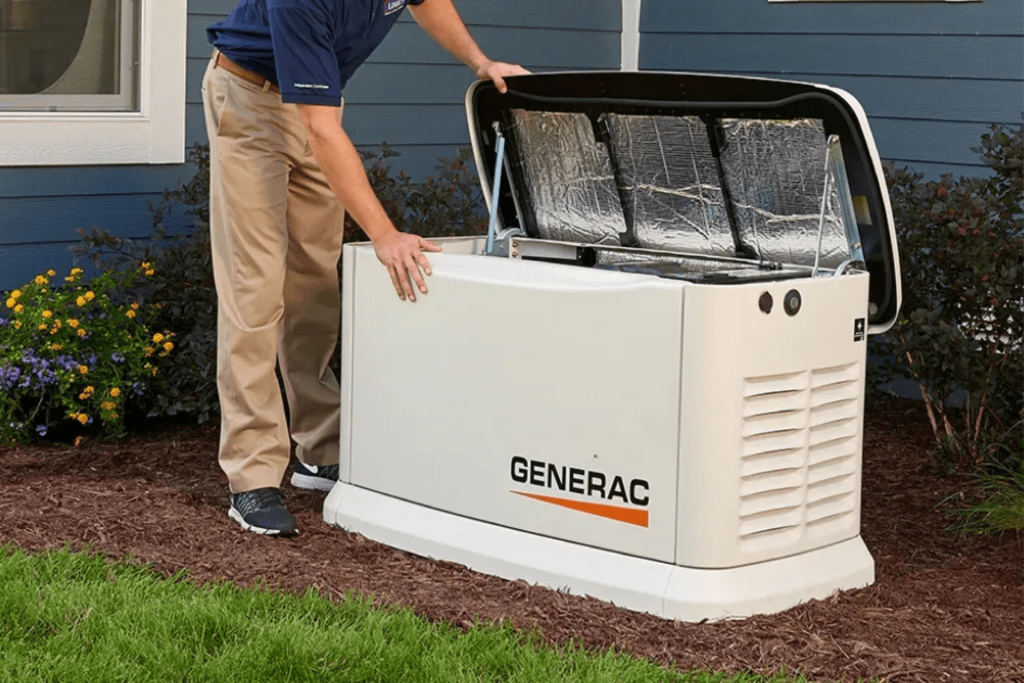
A standby generator that isn’t maintained is a standby generator that may not start. Failures tend to come from skipped service, dead batteries, fuel supply issues, or poor installation.
| When | What to Do |
| Weekly | Let the automatic self-test run, and note any error lights or odd noises |
| Monthly | Look for debris, nests, vegetation, and snow around the unit, and keep clearances open |
| Every 6 months | Check the battery and connections, and clean the enclosure |
| Annually | Oil and filter change, air filter replacement, spark plug check, battery test, and a professional inspection per the manufacturer’s schedule |
| Before storm season | Confirm the unit shows ready, test the transfer, and review propane levels if applicable |
| During long outages | Check the oil level and fuel supply as the manufacturer recommends |
Keep a record. Note service dates and hours. It helps with warranty claims and troubleshooting.
Don’t ignore the transfer switch. It should be tested during service too. A healthy generator is useless if the switch doesn’t move.
When Should You Hire a Professional Generator Installer in Blodgett, OR?
For a standby generator, the short answer is always. The reasons are practical:
- Oregon requires a permit and a licensed electrician for the connection.
- Gas work has to be right. Leaks and undersized lines are safety problems.
- Code and clearances are easy to get wrong.
- Warranty and service often depend on proper installation.
- Inspection. A failed inspection delays everything.
Hire help early if:
- You’re not sure what size you need
- Your panel is old, full, or a fuse box
- Gas service or meter capacity is uncertain
- Your property has a long run between the meter, panel, and generator
- You want load management or a monitored system
What to ask any installer:
- Are you licensed in Oregon, and can I verify it?
- Will you pull the permits and handle inspections?
- Will you do a load assessment, and can I see it?
- Who handles the gas piping or propane tank?
- What’s included in the written estimate?
- What maintenance and service do you offer?
TM Electric LLC is a licensed Oregon electrical company based in Blodgett, serving Albany, Corvallis, Philomath, Newport, and the surrounding area. Its site lists standby generator sizing, installation, maintenance, and repair, along with panel services and upgrades. Call (541) 207-2637 to discuss your property.
FAQ’s
Will I need an electrical panel upgrade?
Maybe. The transfer switch must be rated for your service, and older fuse boxes or crowded panels often need work. An electrician can tell you during the site visit.
Can a standby generator run non-stop through a long outage?
Natural gas can run as long as gas flows. Propane is limited by the tank. Check the oil level and follow the manufacturer’s guidance for extended run times.
How loud is it?
Louder than most people expect, but typically comparable to a central air conditioner. Ask for the manufacturer’s sound rating, and think about placement relative to bedrooms and neighbors.
What if the gas utility shuts off service?
A natural gas unit stops running. Propane or dual-fuel setups keep going on stored fuel. Some units can be converted between fuels, so ask about it.
Is a portable generator with a transfer switch a cheaper option?
It can be. It costs less up front, but you handle fueling, setup, and startup yourself. Oregon requires a proper transfer switch or interlock, and the installation needs a permit and a licensed electrician.
How long does installation take?
The on-site work often takes a few days, but permits, equipment availability, utility coordination, and weather can stretch the overall timeline. Ask for an estimate when you request your quote.